The testing times is a blogspot from Tinius Olsen. It is a record of some of the interesting custom made testing products and gripping solutions which the Design Engineers have developed within Tinius Olsen.
New Materials. New Questions: How Materials Testing is Keeping Pace
New Materials. New Questions: How Materials Testing is Keeping Pace
Properties of the materials being used across manufacturing have fundamentally changed, raising a new set of questions in the realm of materials testing. These stem from “will new physical attributes affect final product performance?” to “how will these new materials perform against proven and relied-upon industry standards?” (Figure 1)
Figure 1. Changes to material properties and characteristics throughout manufacturing are requiring enhanced methods to ensure compliance and confidence in materials testing.
In the face of this uncertainty, materials testing professionals are accessing better research and testing tools as well as standards that are evolving to properly evaluate new material formulations and performance characteristics. Two particularly affected areas are additive manufacturing and recycled and composite polymers, both of which introduce a different set of variables into the processing of materials, which in turn affects materials testing principles.
Additive Manufacturing
Additive manufacturing is quickly moving from R&D into mainstream production, bringing with it a new set of materials, processes and performance variables. It’s becoming even more important to understand the molecular structure, thermal properties and post-processing function of these materials. No longer just about the finished product, there are several other manufacturing variables influencing material performance.
Superalloys in aerospace, power generation and other high-temperature applications require elevated temperature testing to ensure material strength and long-term durability as well as identify deformation under real-world operating conditions. (Figure 2)
Figure 2. As additive manufacturing gains momentum, proper evaluation of next-gen material characteristics becomes crucial to ensuring reliability and upholding quality control.
The standards for evaluating these material characteristics are evolving alongside the technologies. For example, ASTM International’s Committee F42 on Additive Manufacturing Technologies evaluates more than 70 standards that directly impact additive manufacturing to ensure the methods, processes and qualification parameters are inline with this next-generation of materials.
Some key standards the committee oversees include:
ISO/ASTM52900
ISO/ASTM52927
ISO/ASTM52931
ISO/ASTM52933
ISO/ASTM52949
Learn more about Committee F42, which is working to establish a testing environment that aligns with the material properties of today’s additive technologies as they become more prevalent in critical manufacturing applications.
Recycled & Composite Polymers
Melt flow is another area of materials testing where the old principles are being challenged by newer materials, both from recycled plastics and advanced composite formulations. From resins, fillers and reinforcements to processing history, viscosity and flow behavior, each batch of plastics and polymers requires a careful eye on material properties and physical characteristics. (Figure 3)
Figure 3. Today’s polymers can include a combination of recycled plastics, fillers and resins that introduce variables and change the physical properties of material used in manufacturing.
Parameters such as resin-to-reinforcement ratio and material formulation strength matter, especially when additives and recycled content are being introduced to raw material or reformulated batches. Materials testing needs to accurately track what a change in resin formulation looks like or if process timing impacts fiber/filler loading as well as historical melt flow rates (MFR) to provide a predictive path for advanced composites and recycled plastics.
One area where melt flow testing is evolving is test equipment. Loadcell-based melt flow indexing (MFI) enables constant load, extremely detailed accuracy and improved observation when testing these new and inventive compositions.
An added benefit of the new digital system is operator safety, since manual weights are no longer required, and the calibration, testing and cleaning processes are all automated, while still being in full compliance with ASTM D1238 and ISO 1133-1.
Where Data Becomes Critical
The common thread across these changes in materials testing is better access to more detailed data. What do all these results mean? How can the industry use these insights to improve processes moving forward? The goal: develop stronger and more consistent batch-to-batch yield.
Software is the layer transforming disparte machine data into a unified library of information used throughout the materials testing process. Not only do comprehensive platforms, like Horizon, improve reporting and analysis, they actually help streamline workflow, aid in research and development as well as increase traceability in manufacturing operations. (Figure 4)
Figure 4. A comprehensive software platform managing the materials testing environment gives professionals deeper access to data insights, which can be turned into useful trend analysis and operational efficiencies.
Being able to recognize patterns and processing trends that facilitate informed decisions, for example, is a crucial advantage when working with new formulations, additives and composites. Capturing and organizing test results along with specimen and batch data means easier comparisons and improved continuity. Deeper insights through networked data contribute to trends analysis and anomaly detection. Materials testing intelligence increases, leading to a stronger test environment.
Testing with Confidence
As the search for new, better and more effective compositions continues, materials testing professionals are tasked with staying ahead of the curve, and new formulations will introduce news questions. Both the international standards organizations and test system manufacturers are stepping up to provide an enhanced set of parameters and tools that will ensure compliance and safety as material properties continue to evolve.
Together, these resources forge a solid infrastructure that then incorporates a unified data network for an even more comprehensive and confident test environment. Materials will continue to evolve, but test engineers have the means to evaluate, measure and understand them.
These days angioplasty, is an endovascular procedure to widen narrowed or obstructed arteries or veins, is almost considered a routine procedure, yet the technology behind it is exacting and subject to rigorous quality and performance control. In this procedure a n empty, collapsed balloon, known as a balloon catheter, is passed over a wire into the narrowed locations and then inflated to a fixed size. The balloon forces expansion of the narrowing within the artery or vein and the surrounding muscular wall, opening up the blood vessel for improved flow, and the balloon is then deflated and withdrawn. A stent may, or may not, be inserted at the time of ballooning to ensure the vessel remains open. Not only are the stents themselves, and the wire used in their construction, tested for tensile strength, compressive strength and stiffness properties, so too are the balloon catheters used to deliver the stent into the body. In recent times, more attention is being paid to...
One of our most reliable hardness testing systems is the system of choice for one of India’s leading manufacturers of rail wheels, axles and wheel sets. The Rail Wheel Factory, formerly the Wheel and Axle Plant of Bangalore in the Karnataka region of the country, has utilised a Tinius Olsen Air-o-Brinell hardness tester for a great many years and is one of the most popular testing systems the company has produced. The A-o-B is configured into the RWF assembly line so there was no need to set up tests separately, with wheels passing the assembly line to be tested at point. They are then rolled over to another section of the assembly for completion. As a part of Tinius Olsen’s continuing service, we offered RWF one our new generation FH13 hardness testers (Brinell Head only) as an up-grade but the A-o-B has proven such an efficient and economical solution, the company decided to up-grade/refurbish this machine instead. RWF is a state of th...
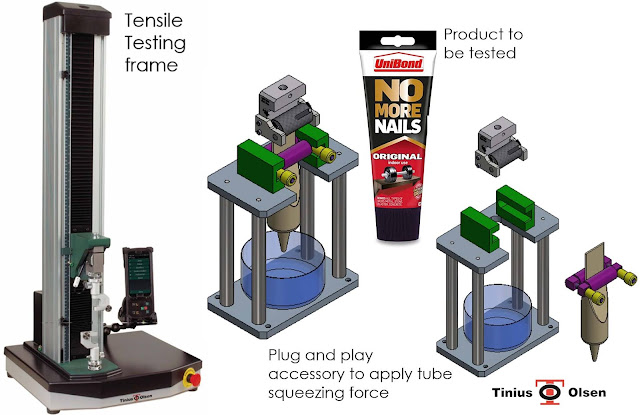
Interesting application; testing and verifying the force required to squeeze a material, in this case an adhesive, from its tube. The accessory applies a squeezing force using a roller set as the tensile frame applies the squeezing motion by pulling the tube up through the rollers. The speed of the pull/squeeze can be accurately defined as required. The output is a graphical representation of the test showing force against movement and time. Forces of interest are automatically captured and reported be it the start force, mid point or just before the tube empties. Through testing like this, manufacturers of tube-based products can prove out the quality of their packaging and ease of use. #InterestingTech #MaterialsScience



Comments